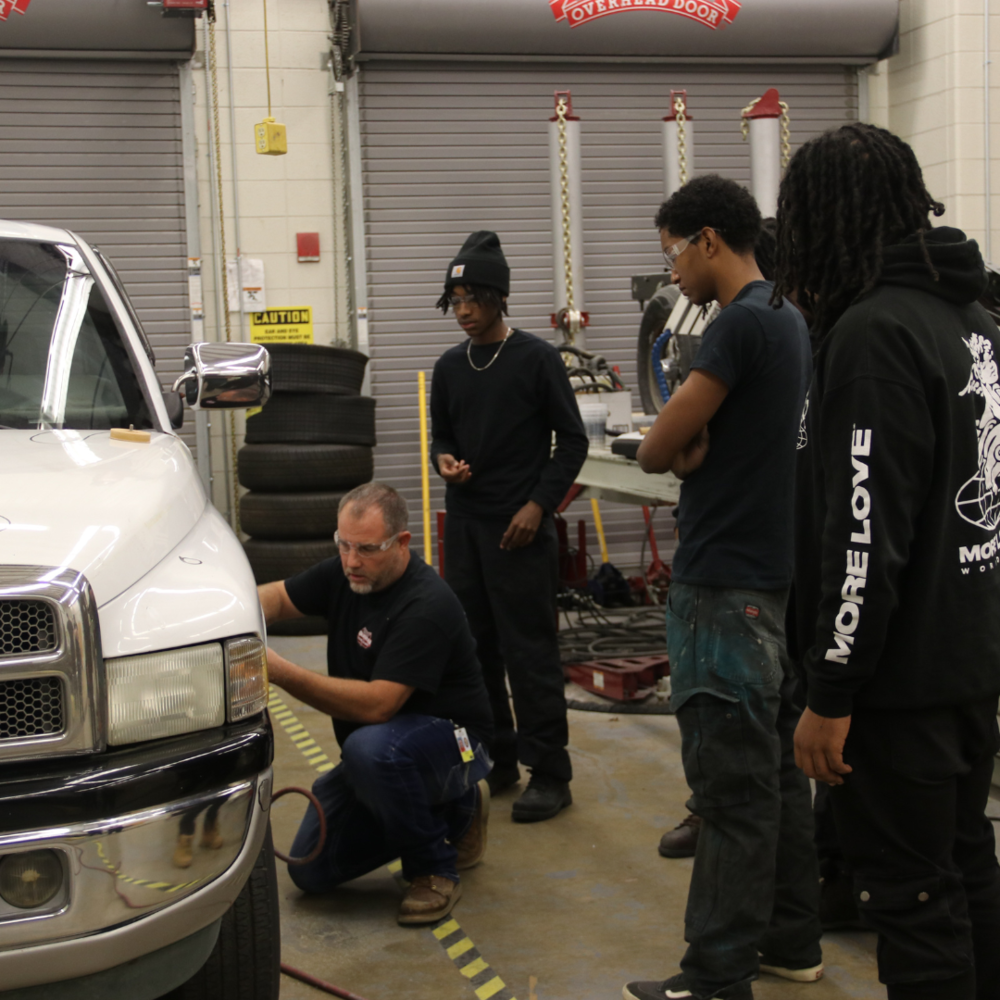
A 2020 graduate of North Point High School found that you can go home again — well, you can visit your former career and technical education (CTE) teacher and current boss at school.
Jarred Wade recently stopped by Jeff Edwards’ classroom at North Point to talk to current students in the auto collision repair program, answering questions ranging from the most challenging repair he has faced so far to how much he earns in a year. Collision repair specialists can pull down the low six figures if they put in the work and “it’s only going up,” Wade said. Students also asked how CTE classes prepared him to enter the workforce.
“The collision program helped me a lot,” Wade said. “It touched base on everything that goes on in the industry. I made connections with people in the automotive field that helped me getting apprenticeships after graduation and that’s what got my foot in the door.”
The collision repair CTE program is designed to introduce and prepare students for a career in the auto finishing and auto body repair field. “This is a great area to start in,” Stone James, a senior, said of the program. “This program opens them up to opportunities. You can take what you learn in this class and apply it to many other fields. It sets a foundation of knowledge.”
The curriculum is in line with National Automotive Technicians Education Foundation (NATEF) and Inter-Industry Conference on Auto Collision Repair (I-CAR) directives. The collision repair program has four certifications available, and Edwards’ students asked Wade about them. Do they really help?
“In school, I did my I-CAR certification,” Wade said. “You still have to do more as you grow, as you become a solo tech. There are plenty of certifications you have to get, you have to take welding classes, take certain classes to reach I-CAR Gold.”
For a shop to be ranked I-CAR Gold, each technician employed in it has to hold so many certifications in certain areas. “If we have an employee like Jarred and he’s got promise, and this is really what he wants to do, [the shop] will spend that money to get him there,” Edwards, collision repair instructor and co-owner of Quality Auto Body & Collison, said. “But in class, it’s free,” he said. “In here learning the I-CAR curriculum, it’s no cost.”
Wade, 21, works at Edwards’ shop in St. Mary’s County. Wade grew up fascinated by cars. His uncle owned his own body shop, “Fast and Furious” movies were on repeat, he tinkered with engines and tore things apart to put them back together. Wade said he never really loved school, but he loved studying cars — how they ran, how they were put together. Applying for CTE programs focused on automotives was a natural fit — he dual enrolled in automotive technology and collision repair at North Point.
“The collision program helped me a lot,” Wade said. “It touched on everything that goes on in the industry. I made connections with people in the automotive field that helped me with getting apprenticeships. That’s what got my foot in the door.”
Wade talked about an average day on the job — though there are no “average” days. “Every day is a new adventure,” he said. Right now, the lot is full of vehicles needing repairs, leaving no room for employees to park. Tow trucks are rolling in almost every hour with new work, people are stopping by asking for their cars to be repaired. “Our lot now is completely jam packed,” Wade said. “That’s a good thing. That means more money.”
Wade said along with knowing how to work with cars, dealing with insurance companies on how many hours a repair should take versus how long it will take, shop employees must know how to work with customers — the good, the bad and the annoying. “Truthfully, you have to have social skills,” Wade said. “You have to be able to talk to people. You can’t clam up, you can’t hide. You have to be straight forward and ask questions.”
The collision repair program is one of the CTE programs eighth grade students can apply for by 3 p.m., Tuesday, Nov. 14. To learn more about CTE, visit the department’s webpage. Applications are housed at the department’s site at www.ccboe.com.
About CCPS
Charles County Public Schools provides 27,598 students in grades prekindergarten through 12 with an academically challenging education. Located in Southern Maryland, Charles County Public Schools has 37 schools that offer a technologically advanced, progressive and high quality education that builds character, equips for leadership and prepares students for life, careers and higher education.
The Charles County public school system does not discriminate on the basis of race, color, religion, national origin, sex, sexual orientation, gender identity, age or disability in its programs, activities or employment practices. For inquiries, please contact Kathy Kiessling, Title IX/ADA/Section 504 Coordinator (students) or Nikial M. Majors, Title IX/ADA/Section 504 Coordinator (employees/ adults), at Charles County Public Schools, Jesse L. Starkey Administration Building, P.O. Box 2770, La Plata, MD 20646; 301-932-6610/301-870-3814. For special accommodations call 301-934-7230 or TDD 1-800-735-2258 two weeks prior to the event.
CCPS provides nondiscriminatory equal access to school facilities in accordance with its Use of Facilities rules to designated youth groups (including, but not limited to, the Boy Scouts).